A certificate of copyright registration and deposit serves as official documentation issued by the copyright office, affirming the registration of a creative work such as a book, music composition, or artwork. This certificate is incontrovertible evidence of the work’s protection under copyright law.
In addition to the certificate, the deposit entails submitting a physical or digital copy of the work to the copyright office during registration. This deposit is essential for documenting the creation and ownership of the work.
Now, let’s delve deeper into copyright registration and deposit details.
- Entities authorized to act on behalf of authors, creators, or copyright owners, including attorneys and agents, can also apply for registration.
- After completing the copyright application form, you must submit a copy of your original work as a deposit.
- To request copies of deposits made in connection with a copyright claim, several conditions must be met.
Table of Contents
Who Can Apply for a Certificate of Copyright Registration and Deposit?
Applying for a certificate of copyright registration and deposit is an important step for creators seeking legal protection for their original works. This official document, issued by the copyright office, validates the ownership of creative content and establishes rights and protections under copyright law.
- Authors and Creators: Individuals who have authored or created original works, such as writers, artists, musicians, filmmakers, and software developers, can apply for copyright registration.
- Copyright Owners: Copyright ownership may be distinct from authorship, allowing owners of copyrighted works, such as publishers, production companies, and employers, to apply for registration.
- Legal Representatives: Individuals or entities authorized to act on behalf of authors, creators, or copyright owners, including attorneys and agents, can also apply for registration.
- Assignees and Licensees: Those who have acquired rights to copyrighted works through assignment or licensing agreements may also apply for registration, provided they have the legal authority to do so.
In conclusion, the eligibility to apply for a certificate of copyright registration and deposit extends to a diverse range of individuals and entities involved in creating, owning, and representing original works. By obtaining this certificate, they can secure legal recognition and protection for their intellectual property.
What Are the Requirements for Applying for a Certificate of Copyright Registration and Deposit?
Now, let’s talk about what you need in order to apply for a certificate of copyright registration and deposit. These requirements dictate the necessary documentation and materials needed for a successful copyright registration process.
- Completed Application Form: Applicants must fill out the appropriate copyright registration application form provided by the copyright office.
- Deposit Copy of the Work: A physical or digital copy of the original work must be submitted as part of the registration process. The format of the deposit copy may vary depending on the type of work being registered.
- Applicable Fee Payment: Payment of the required registration fee is necessary for processing the copyright application. The fee amount may vary depending on factors such as the type of work and the method of submission.
- Power of Attorney (if applicable): If applying through a legal representative, such as an attorney or agent, a valid power of attorney document authorizing representation may be required.
How to Apply for a Certificate of Copyright Registration and Deposit?
The application process involves several steps to ensure the proper documentation and submission of materials required for copyright registration. Follow this step-by-step guide to manage the application process effectively:
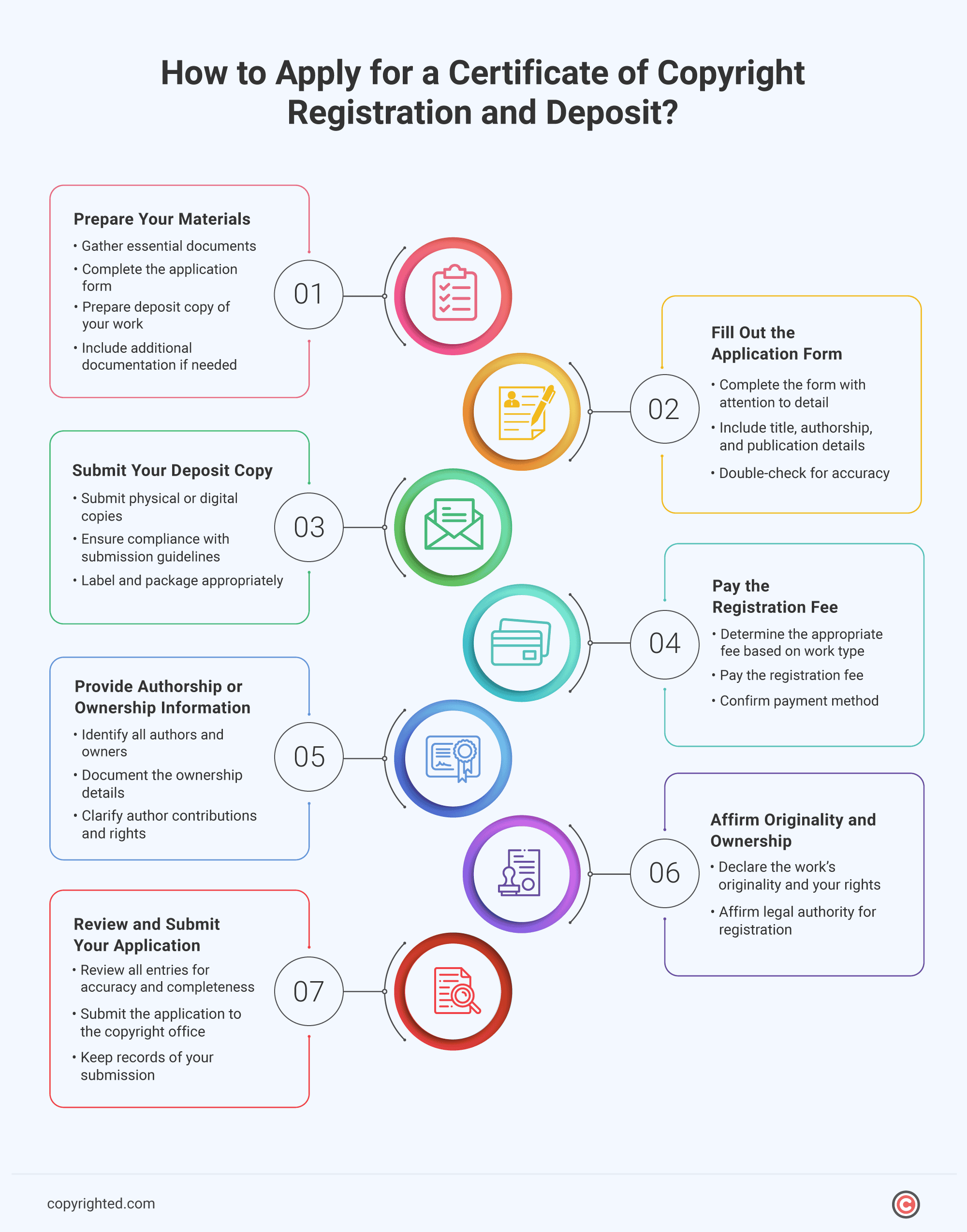
Step 1: Prepare Your Materials
Before initiating the copyright registration process, gathering all the necessary materials is essential. These materials typically include:
- Completed Application Form: Obtain the appropriate copyright registration application form from the designated copyright office. Ensure you select the correct form corresponding to the type of work you intend to register.
- Deposit Copy of Your Work: Prepare a physical or digital copy of the original work you wish to copyright. The format of the deposit copy may vary depending on the nature of the work — this could be a manuscript, recording, artwork, or digital file.
- Additional Documentation (if required): Some copyright registrations may require supplementary documentation. This could include permissions for copyrighted materials used within your work, such as excerpts from other publications or copyrighted images.
Step 2: Fill Out the Application Form
Once you’ve gathered all the necessary materials, proceed to complete the copyright registration application form. Pay close attention to the instructions provided with the form and ensure that all fields are accurately filled out with the required information.
The information typically includes:
- Title of the Work: Provide the title of your copyrighted work. This should be clear, descriptive, and accurately represent the content of your creation.
- Authorship Information: Include details about the author or authors of the work. This may include the names, pseudonyms, or other identifying information of the individuals responsible for creating the work.
- Publication Details: If the work has been published, provide information about the publication, including the date and place of publication, the publisher’s name, and any relevant ISBN or ISSN numbers.
Step 3: Submit Your Deposit Copy
After completing the application form, you must submit a copy of your original work as a deposit. Ensure that the format of the deposit copy complies with the copyright office’s guidelines for the type of work being registered.
If submitting physical copies, ensure they are properly packaged and labeled according to the copyright office’s specifications. If submitting digital copies, follow the prescribed file format and size requirements and ensure the file is accessible and can be easily reviewed by copyright office personnel.
Step 4: Pay the Registration Fee
You must pay the applicable registration fee once the application form and deposit copy are prepared. The fee amount may vary depending on factors such as the type of work being registered, the number of works included in the application, and the method of submission.
Be sure to check the current fee schedule provided by the copyright office and arrange for payment accordingly.
Step 5: Provide Authorship or Ownership Information
In this step, provide accurate information regarding the authorship or ownership of the registered copyrighted work. This may involve:
- Identifying Authors: Clearly identify all authors or creators involved in producing the work. Include their names, contact information, and any relevant details about their contributions to the work.
- Establishing Ownership: If the copyright ownership differs from authorship (e.g., in the case of works created under employment or commissioned works), provide documentation or agreements establishing ownership rights.
Step 6: Affirm Originality and Ownership
As part of the application process, you’ll need to provide a statement affirming the originality of the work and your ownership or authorship rights. This statement declares the work’s authenticity and your rights as the creator or owner.
Be prepared to attest that the work being registered is original, not a reproduction or adaptation of another copyrighted work, and that you have the legal authority to register the copyright.
Step 7: Review and Submit Your Application
Before finalizing your copyright registration application, carefully review all provided information and documentation for accuracy and completeness. Ensure that all required fields are properly filled out, and all supporting materials are included.
Once everything is in order, submit your application to the designated copyright office for processing. Keep records of your submission for future reference and tracking.
How to Request a Copy of the Certificate of Copyright Registration?
Requesting a copy of the Certificate of Registration involves a straightforward process, typically managed through the copyright office where the registration was filed. Below is a detailed guide on how to request a copy of the certificate and what the request should include:
Step 1: Determine the Copyright Office
Identify the specific copyright office where the registration for your work was filed. Depending on your jurisdiction, this could be a national or a regional copyright office.
Step 2: Contact the Copyright Office
Reach out to the copyright office via phone or email or visit their website to inquire about the process for requesting a copy of the Certificate of Copyright Registration. Most copyright offices provide detailed instructions and forms for this purpose.
Step 3: Provide Necessary Information
When requesting a copy of the certificate, be prepared to provide the following information:
- Copyright Registration Number: If available, include the registration number assigned to your copyrighted work. This helps the copyright office locate the registration record quickly.
- Title of the Work: Provide the title of the copyrighted work for which you are requesting the certificate. This helps ensure accuracy in locating the registration record.
- Author or Owner Information: Include the name(s) of the author(s) or owner(s) associated with the copyrighted work. This information further assists the copyright office in identifying the correct registration record.
Step 4: Complete Any Required Forms
The copyright office may require you to fill out a specific request form to obtain a copy of the Certificate of Copyright Registration. Ensure that you complete the form accurately and provide all requested information.
Step 5: Pay Any Applicable Fees
Some copyright offices may charge a fee for providing a copy of the Certificate of Copyright Registration. Be ready to cover any applicable fees as specified by the copyright office, including details on fee amounts and accepted payment methods.
Step 6: Submit the Request
Submit your request for a copy of the certificate to the copyright office using their specified method of submission. This may involve mailing the request form and any supporting documents, submitting the request online through a designated portal, or visiting the copyright office in person.
Step 7: Await Processing
Once the request is submitted, allow the copyright office some time to process the request and generate a copy of the Certificate of Copyright Registration. Processing times may vary depending on the copyright office’s workload and the request submission method.
Step 8: Receive and Verify the Copy
Once processed, the copyright office will provide you with a copy of the Certificate of Copyright Registration. Upon receiving the copy, carefully review it to ensure that all information is accurate and matches your original registration details.
How to Request a Copy of Deposits?
Several conditions must be met to request copies of deposits made in connection with a copyright claim. Here’s a detailed explanation of the process and the three conditions that must be satisfied:
All requests for copies of deposits should be sent to the Records Research and Certification Division of the Copyright Office. This division handles requests for reproductions of copyrighted works deposited for registration.
The Copyright Office will provide certified or uncertified copies of published or unpublished works deposited in connection with a copyright registration only under the following conditions:
- Written Authorization from Copyright Claimant: Copies of deposits can be provided if written authorization is received from the copyright claimant or owner of any exclusive rights in the copyright, with accompanying documentation demonstrating ownership transfer required for the request. If the transfer of copyright is recorded in the Copyright Office, relevant information such as volume and page numbers should be provided.
- Completion of Copyright Office Litigation Statement Form: If a Copyright Office Litigation Statement Form is completed and received from an attorney or authorized representative in connection with litigation involving the copyrighted work, copies of deposits can be provided; the form must contain detailed information about the parties involved, the nature of the controversy, and the court where the case is pending. For prospective proceedings, a full statement of the facts of the controversy must be provided along with supporting documents.
- Court Order Issued: If a court order is issued for the reproduction of a deposited article, or identifying portion of a work that is the subject of litigation, copies of deposits can be provided. The court order must be issued by a court having jurisdiction over the case where the copy will be submitted as evidence.
A request for copies of works deposited in connection with a copyright claim should be accompanied by material demonstrating that one of the three conditions mentioned above has been met.
The requester will be informed if a deposit is not retained under the Copyright Office’s control. For deposits selected for the Library of Congress collections, inquiries can be made directly to the Library of Congress.
Frequently Asked Questions
What is the difference between copyright registration and copyright deposit?
Copyright registration involves submitting an application and materials to the copyright office to legally protect a work, while copyright deposit refers to the submission of the actual copy of the work as part of the registration process.
How long does it take to receive a copyright certificate?
The time to receive a copyright certificate varies depending on the workload of the copyright office. Processing and issuance typically take several weeks to several months.
How much is the fee for the certificate of copyright registration and deposit?
The fee for the certificate of copyright registration and deposit varies depending on factors such as the type of work and the method of submission. Detailed fee schedules are available from the copyright office.
Do you need a certificate of copyright registration to claim copyright?
No, a certificate of copyright registration is not required to claim copyright. Copyright protection automatically applies to original works upon creation. However, registration provides additional legal benefits and is often recommended.
What happens if the deposit submitted for copyright registration is incomplete or inadequate?
If the deposit submitted for copyright registration is incomplete or inadequate, it may delay or affect the registration process. The copyright office may request additional materials or information to complete the registration.