Copyright compliance is a legal obligation, but many businesses, creators, and organizations overlook it, sometimes without realizing the risks.
Using copyrighted content without permission can lead to lawsuits, fines, or harm to your reputation. Even accidental violations may result in legal consequences.
Copyright rules can be confusing, and mistakes are easy to make. Questions like whether you need a license for a stock photo, if you can legally use a short music clip, or how much of an article you can quote can have costly consequences if misunderstood.
This Copyright Compliance Checklist will guide you through the rules and help you avoid common pitfalls. You’ll learn when permission is necessary, how to use content legally, and how to protect your work.
- Ensure copyright compliance to protect businesses, creators, and organizations from legal risks, financial penalties, and reputational harm.
- Fair use is a legal defense, not an automatic right, and misinterpreting it can still lead to infringement claims.
- Proper licensing, attribution, and monitoring tools help ensure legal content use while minimizing copyright violations.
Table of Contents
Why is Copyright Compliance Important?
Copyright compliance is essential because violating copyright laws can lead to lawsuits, financial penalties, and reputational damage. Proper compliance protects businesses and creators from legal trouble while ensuring fair use of intellectual property.
Failing to comply with copyright laws can result in serious consequences, including:
- Legal Penalties and Lawsuits: Under 17 U.S. Code § 504, copyright infringement can lead to statutory damages of up to $150,000 per work, plus additional legal fees. Businesses and individuals may also face civil lawsuits.
- Fines and Financial Losses: If a court rules against you, you may be required to pay damages to the copyright owner. Even accidental infringement can result in costly settlements.
- Reputational Damage: Being accused of copyright infringement can harm a company’s or creator’s credibility. It may lead to losing customers, sponsors, or business partnerships.
- Content Removal and Business Disruptions: Platforms like YouTube, Instagram, and websites may remove infringing content, resulting in lost engagement and revenue. Repeated violations can lead to account suspension or permanent bans.
On the other hand, following copyright laws has advantages beyond avoiding penalties. These include:
- Legal Protection for Your Own Work: By respecting others’ copyrights, you also strengthen the protection of your original content.
- Stronger Business Reputation: Ethical content builds customer, partner, and investor trust.
- Access to Licensed Content: Proper licensing agreements allow you to use high-quality images, music, and text legally and professionally.
- Fewer Legal Risks: Clear policies on copyright reduce the chances of facing legal disputes, saving time and money.
Understanding and following copyright laws ensures long-term success for businesses and content creators while maintaining fair practices in the digital and creative industries.
Who Needs to Follow Copyright Compliance?
Everyone who uses copyrighted material must follow copyright laws. Under 17 U.S. Code § 106, copyright owners have exclusive rights over their work, meaning others cannot use it without permission or legal exceptions.
1. Businesses and Organizations
Companies use copyrighted materials in marketing, branding, training materials, and product designs, but using images, videos, or text without permission can lead to lawsuits. Even stock images and fonts require proper licensing.
2. Content Creators
YouTubers, bloggers, podcasters, musicians, and social media influencers frequently use copyrighted music, videos, and graphics. Many assume short clips or “fair use” protect them, but misinterpretation can result in content removal or copyright strikes on platforms like YouTube.
3. Educators and Researchers
Teachers, professors, and researchers often use books, articles, images, and videos in classrooms, online courses, and publications.
The Technology, Education, and Copyright Harmonization (TEACH) Act under 17 U.S. Code § 110 allows limited use of copyrighted works for educational use, but strict conditions apply. Universities and schools must ensure compliance.
4. Software Developers and Website Owners
Developers must ensure that software and websites’ source code, images, fonts, and plugins are correctly licensed. Copying or modifying code without permission can lead to copyright claims, and open-source software has specific licensing terms that must be followed.
5. Journalists and Media Outlets
News agencies, freelance writers, and media companies must adequately attribute and obtain rights for images, videos, and text. Simply crediting a source does not grant legal permission to use copyrighted material.
6. Event Organizers and Public Speakers
Using copyrighted music, videos, or images in presentations, conferences, or live events without a proper license can lead to copyright claims. Public performance rights apply even in non-commercial settings.
Copyright Compliance Checklist
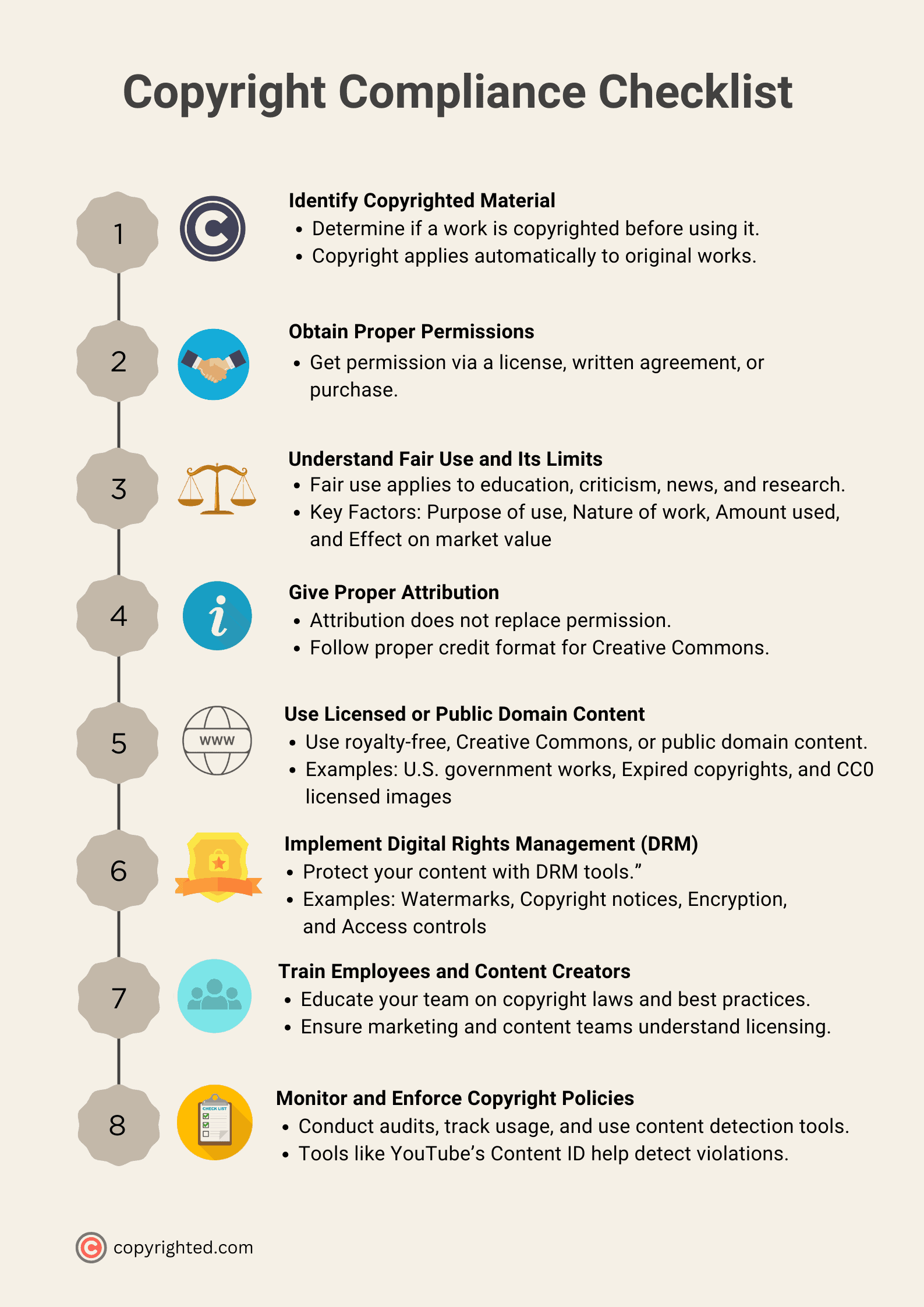
Following a structured approach helps businesses, creators, and organizations avoid copyright violations. The checklist below outlines key steps to ensure compliance.
1. Identify Copyrighted Material
Before using any content, determine whether your work is copyrighted. According to 17 U.S. Code § 102, copyright protection applies automatically to original works fixed in a tangible medium, meaning a creator doesn’t need to register their work for it to be protected.
2. Obtain Proper Permissions
If a work is copyrighted, you must obtain permission from the copyright owner to use it unless an exception applies. Permissions can come as a license, a written agreement, or a direct purchase.
3. Understand Fair Use and Its Limits
Fair use, under 17 U.S. Code § 107, allows limited use of copyrighted material without permission for purposes like commentary, criticism, news reporting, teaching, and research.
However, fair use is assessed based on these four factors:
- The purpose and character of the use
- The nature of the copyrighted work
- The amount used for the whole work
- The effect on the market value of the original work
For example, using a short clip of a movie in a film critique may qualify as fair use, but using the same clip in a product advertisement would likely require a license. Since fair use is a legal defense, not an automatic right, misinterpreting it can lead to legal risks.
So, before incorporating any copyrighted material into your work, determine whether your proposed use falls within the fair use analysis.
4. Give Proper Attribution
Attribution means crediting the original creator, but it does not replace the need for permission. Some licenses, such as those under Creative Commons, require attribution as a condition of use.
For instance, if a blog post includes an image under a CC BY 4.0 license, the author must provide proper credit, such as:
Photo by Jane Doe, used under Creative Commons Attribution 4.0 License.
Failure to attribute correctly could violate the terms of the license and result in a takedown request or legal claim.
5. Use Licensed or Public Domain Content
Consider using licensed content or materials in the public domain to avoid copyright issues. Public domain works are not protected by copyright and can be used freely. Some examples are:
- U.S. government works
- Works with expired copyrights
- Creative Commons Zero (CC0) licensed content
Many stock websites offer royalty-free images with broad usage rights. However, always check the licensing terms before use.
6. Implement Digital Rights Management (DRM)
Digital Rights Management (DRM) tools help prevent unauthorized copying and distribution for businesses and content creators distributing copyrighted material. These methods enhance security and protect intellectual property:
- Watermarks on images and videos
- Copyright notice
- Encrypted e-books or digital content
- Access controls for software and media files
7. Train Employees and Content Creators
Companies and organizations should educate employees, content teams, and marketing departments on copyright laws and best practices. Training should cover licensing agreements, recognizing copyrighted materials, and following fair use guidelines.
8. Monitor and Enforce Copyright Policies
Regular audits help businesses stay compliant. Reviewing website content, tracking social media usage, and using content detection tools can prevent unauthorized use.
For example, YouTube’s Content ID allows copyright owners to monitor their content and choose to block, monetize, or track unauthorized uploads. Setting up internal content reviews can also help maintain compliance.
Legal Consequences of Non-Compliance
Ignoring copyright laws can lead to serious legal and financial consequences. Copyright owners have the right to take action against unauthorized use; even unintentional violations can result in penalties. Below are the key risks of non-compliance.
Fines and Penalties for Copyright Infringement
Copyright owners can seek damages and statutory penalties for infringement. If proven, the infringer may be required to pay actual damages, which include lost profits and licensing fees.
In cases where damages are difficult to calculate, courts may impose statutory damages ranging from $750 to $30,000 per work. If the infringement is found to be willful, the penalty can increase to $150,000 per work.
Businesses that use copyrighted images, videos, or music without proper licensing can face costly lawsuits. Even if a company unknowingly violates copyright laws, it is still liable for damages.
DMCA Takedown Requests and Content Removal Risks
The Digital Millennium Copyright Act (DMCA) under 17 U.S. Code § 512 provides copyright owners with a legal mechanism to request the removal of infringing content from websites, social media platforms, and online services.
Platforms like YouTube, Facebook, and Instagram have automated systems that allow copyright owners to file takedown requests.
Repeated DMCA violations can result in content removal, account suspension, or permanent bans. Websites that host infringing material may also be de-indexed from search engines or taken down by web hosting providers for failing to comply with DMCA rules.
Potential Lawsuits and Damage to Business Reputation
Copyright owners can sue for damages, leading to lengthy and expensive legal battles. Multiple claims may escalate to class-action lawsuits, increasing financial liability.
A copyright lawsuit can also harm a company’s reputation. Losing customer trust, losing advertisers, or severing business partnerships are common consequences. Even settling a case outside of court can be costly due to legal fees and settlement amounts.
Criminal Charges for Willful Infringement
Under 17 U.S. Code § 506 and 18 U.S. Code § 2319, copyright infringement can be a criminal offense if the violation is willful and involves commercial gain. Criminal penalties may apply in cases where an individual or business intentionally distributes copyrighted material for profit.
Criminal copyright infringement can result in fines of up to $250,000 and imprisonment for up to five years for a first-time offense.
Repeat offenders may face longer sentences. Law enforcement agencies prosecute large-scale copyright violations, especially in cases of piracy and counterfeiting.
Loss of Monetization and Revenue Streams
Many online platforms have copyright enforcement policies that affect monetization.
YouTube’s Content ID system automatically detects copyrighted video content and allows copyright owners to claim revenue from ads. If a business or creator uses copyrighted music or footage, they may lose all ad revenue to the original copyright holder.
Repeated copyright violations can lead to demonetization, restrictions on content distribution, or permanent bans from platforms. These penalties can have a lasting financial impact on businesses that rely on digital content for marketing and revenue.
Restrictions on Future Content Use
Copyright violations can result in blacklisting by licensing agencies or rights holders, which makes it difficult for businesses and creators to obtain legal permissions for future projects.
If a company or individual has a history of infringement, they may face stricter licensing terms or be denied access to stock images, music libraries, or publishing platforms.
Frequently Asked Questions
How do you know if something is copyrighted?
Most original works are automatically copyrighted if fixed in a tangible medium, such as books, images, videos, and music.
What is the best way to get permission to use copyrighted material?
Contact the copyright owner for a license or written permission, or use content with a valid Creative Commons or royalty-free license.
What happens if you don’t follow copyright compliance?
You may face lawsuits, fines up to $150,000 per work, content takedowns, and reputational damage.
What tools can help with copyright compliance?
Content detection tools like YouTube’s Content ID, Digital Rights Management (DRM), and licensing databases help track and manage copyrighted material.
What should you do if you receive a DMCA takedown notice?
Remove the content immediately, review the claim’s validity, and file a counter-notice if you believe the takedown was in error.