Sharing content online has never been easier, and that means it’s also easier than ever to misuse someone else’s work without realizing it.
But when that happens, the Digital Millennium Copyright Act (DMCA) steps in. The DMCA is a U.S. law that protects digital content and enforces copyright protection by punishing violations.
If you break these rules, even by mistake, you could face serious civil and criminal penalties, including fines or imprisonment.
What makes this worse? Many people don’t understand the full scope of DMCA enforcement until it’s too late. A takedown notice, a fine, or even criminal charges can follow a single misstep.
This article breaks down the different types of DMCA penalties and explains what happens if you file a false claim or try to bypass digital protections. You’ll also learn how to defend yourself against DMCA penalties.
- DMCA violations can result in civil lawsuits, criminal charges, and platform bans, depending on the offense’s severity.
- False DMCA claims are illegal and can lead to financial and legal consequences for the person who files them.
- Bypassing digital protections like DRM is a serious offense under the DMCA, even for personal use.
Table of Contents
Types of Digital Millennium Copyright Act (DMCA) Penalties
Violating the DMCA can lead to serious consequences, depending on the nature and severity of the offense.
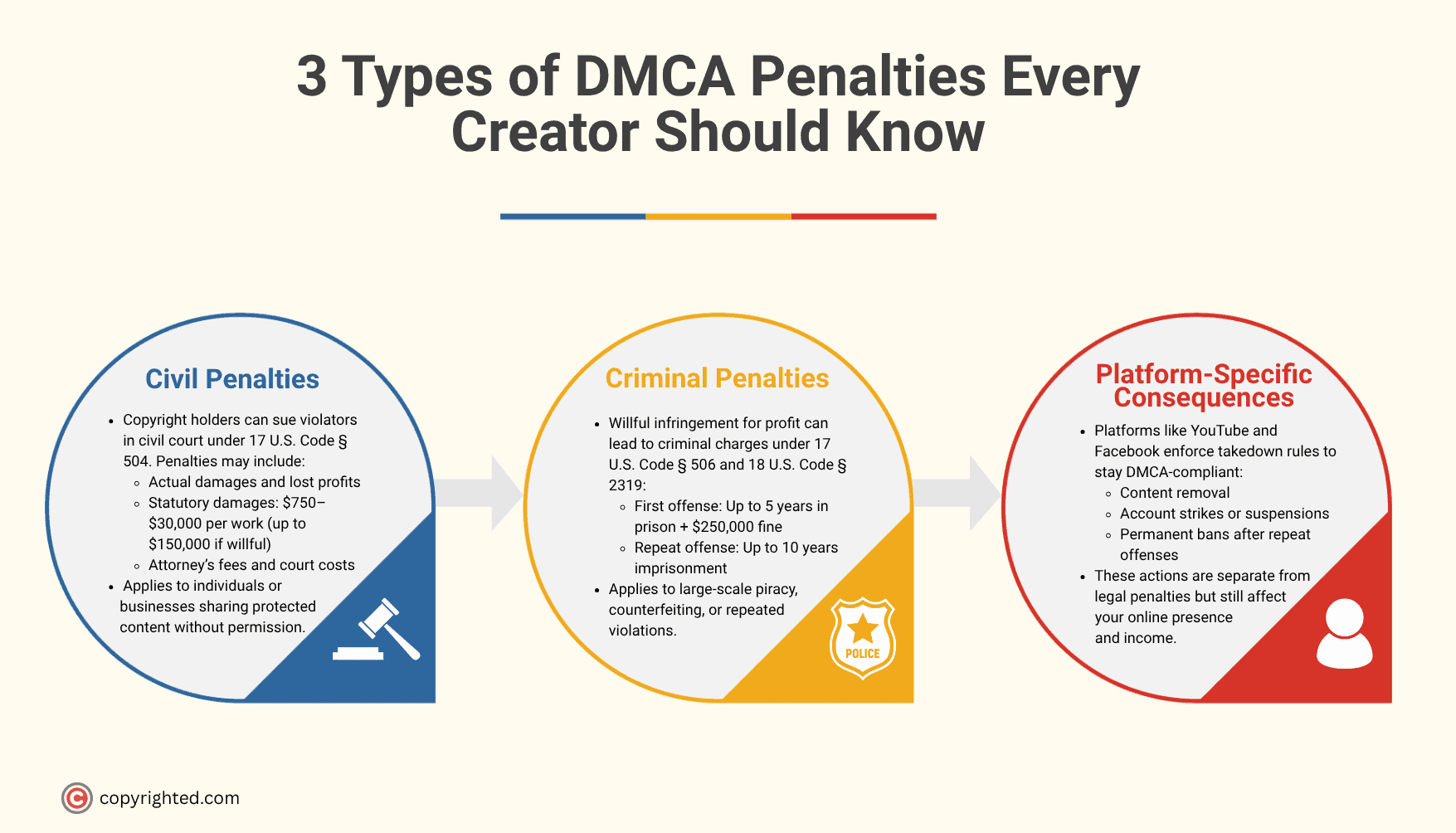
Penalties generally fall into three main categories: civil penalties, criminal penalties, and consequences enforced by online platforms. Understanding these penalties is important if you create, share, or host digital content.
Below is a breakdown of each type, based on how the DMCA is enforced under 17 U.S. Code § 512.
1. Civil Penalties
Civil penalties usually apply when someone uses copyrighted material without permission. Based on 17 U.S. Code § 504, copyright holders can sue violators in civil court.
The court may award:
- Actual damages and profits: The copyright owner can recover the money they lost and any profits the violator made.
- Statutory damages: If actual damages are hard to calculate, the court may award between $750 and $30,000 per work. If the court finds the violation was willful, the amount can go up to $150,000 per work.
- Attorney’s fees and court costs: In many cases, the losing party must pay the winner’s legal fees.
These penalties can apply to individuals, businesses, or anyone who distributes or reproduces protected content without proper authorization, including on peer-to-peer networks or through file sharing.
2. Criminal Penalties
Some violations go beyond civil law and become criminal offenses, especially if the infringement is willful and done for commercial gain. Under 17 U.S. Code § 506 and 18 U.S. Code § 2319:
- First-time offenders may face up to 5 years in prison and fines of up to $250,000.
- Repeat offenders can receive up to 10 years’ imprisonment.
Criminal charges are typically reserved for large-scale piracy, counterfeit operations, or cases involving repeated, intentional violations, such as those found in motion picture distribution rings.
3. Platform-Specific Consequences
Online platforms like YouTube, Facebook, and Etsy follow the DMCA’s safe harbor rules. To stay protected, these platforms and even internet service providers must remove or disable access to allegedly infringing content when they receive a valid DMCA takedown notice.
Consequences for users include:
- Content removal
- Channel strikes or suspensions
- Permanent bans after repeated violations
These actions are separate from legal penalties but can still impact your reputation, income, or ability to publish content online.
Penalties for Filing False DMCA Claims
Filing a false DMCA takedown notice is illegal. The DMCA aims to protect creators, but it also includes rules to prevent misuse of the system.
Anyone who knowingly makes a false claim about copyright infringement can be held responsible for damages, which may include:
- Financial losses suffered by the accused party, such as lost income or harm to their reputation
- Attorney’s fees
- Court costs
This rule applies to both takedown notices and counter-notifications. If someone files a claim without holding the exclusive rights to the intellectual property or provides false information, they can be sued in civil court by the affected party.
Penalties for Circumventing Digital Rights Management (DRM)
Circumventing Digital Rights Management (DRM) is a direct violation of the DMCA, even if you don’t copy or share the content. The law makes it illegal to bypass technologies that control access to copyrighted works, such as encryption, license keys, or access codes.
This is covered under 17 U.S. Code § 1201, which prohibits:
- Bypassing access controls (like cracking software or ripping DVDs with encryption)
- Creating or distributing tools that help others bypass DRM
Civil Penalties
If you violate this section, you can be sued in civil court. Possible outcomes include:
- Actual damages or statutory damages
- Injunctions to stop the activity
- Forfeiture of devices used in the violation
- Attorney’s fees and court costs
Criminal Penalties
According to 17 U.S. Code § 1204, criminal penalties apply if the violation is willful and done for commercial advantage or financial gain:
- Up to 5 years in prison and/or
- Fines up to $500,000 for a first offense
- Up to 10 years in prison and/or
- Fines up to $1,000,000 for repeat offenses
DRM violations are taken seriously because they target the core protections that copyright holders rely on to control access to their content. Even individuals who bypass DRM for personal use may be at risk under the law.
How to Defend Against DMCA Penalties
You can defend yourself against DMCA penalties, but you need to act fast and follow the correct steps. The DMCA outlines procedures for responding to takedown notices and disputing false or mistaken claims.
In more serious cases, legal defenses like fair use or lack of infringement may also apply. Here’s how to respond:
Step 1: Review the Notice Carefully
Start by reading the DMCA notice. Check what content was flagged and why. A valid notice must include details about the copyrighted work, the content in question, and contact information from the person filing the complaint.
If the notice is missing any required elements, it may not be valid.
For guidance on valid DMCA notice requirements, creators can refer to resources published by the U.S. Copyright Office, which maintains detailed documentation and policies related to takedown procedures and rights of both content owners and users.
Step 2: Check If Your Use Was Legal
Determine if your use may be protected under fair use or 17 U.S. Code § 107. Uses like commentary, criticism, education, or parody might qualify. Also, consider if the material is in the public domain or if you had permission to use it.
Step 3: File a Counter-Notice
If your content was removed from a platform, you can submit a counter-notification under Title 17 of the United States Code, Section 512. Your counter-notice should explain why the takedown was incorrect and confirm you’re willing to resolve the matter in court if needed.
Include your contact details and a statement made under penalty of perjury. If the original claimant doesn’t file a lawsuit within 10 to 14 business days, the platform may restore your content.
Step 4: Collect Evidence
If the situation continues, gather proof such as original files, licenses, permissions, or emails showing your right to use the content. Keeping clear records can help if the matter ends up in court.
Step 5: Get Legal Help
If you’re unsure about how to proceed or if penalties are severe, consult a copyright lawyer. They can help you build a solid defense and represent you if legal action is taken.
Step 6: Respond Quickly to Legal Action
If the other party files a lawsuit, respond immediately. Ignoring it can lead to a default judgment, which might result in large fines. Make sure to follow all legal procedures and meet court deadlines.
Frequently Asked Questions
How many DMCA strikes can you get?
Most platforms enforce a three-strike policy; after three valid DMCA strikes, your account may be suspended or permanently banned.
Can unauthorized content uploads lead to DMCA action?
Absolutely. Unauthorized use or sharing of copyrighted content, whether intentional or accidental, can trigger takedown notices, civil penalties, or even criminal consequences.
Do you need a lawyer if you’re facing a DMCA penalty?
While not always required, hiring a lawyer is strongly recommended if you’re facing serious claims or legal action.
Are DMCA penalties the same in every country?
No, the DMCA is a U.S. law, and other countries have their own copyright laws, which may differ significantly.
How do you avoid DMCA violations?
Use original content, obtain proper licenses, and understand fair use to minimize the risk of DMCA violations.