Creating a digital product such as an eBook, online course, mobile app, or design template requires time and creative effort.
However, once a work is published online, it becomes easy for others to copy, sell, or use it without permission. This poses a real problem for creators who rely on their work for income or brand growth.
So, how do you prove ownership? And how do you stop others from using your work without consent?
That’s where copyright comes in, giving you the legal right to control how your digital product is used. Still, many creators aren’t sure how to get that protection or assume the process is too complex.
This article explains how to copyright a digital product in simple steps, covering what copyright protects, how to register your work, and how to safeguard your rights under U.S. law. Understanding this process can help you avoid legal issues and protect your creations.
- Copyright protection for digital products begins automatically once the work is saved in a fixed format, but registration enhances enforceability.
- Registering a copyright holder’s digital product involves a straightforward online process through the U.S. Copyright Office. The method includes uploading a file and paying a filing fee.
- Enforcing copyright may involve takedown notices, legal warnings, or federal lawsuits, especially if the work is registered and infringement continues.
Table of Contents
Does Copyright Apply to Digital Products?
Yes, digital products are protected by copyright.
Under U.S. law, original works are automatically protected when fixed in a tangible medium of expression, including digital formats.
According to 17 U.S. Code § 102, literary, musical, and artistic works are protected once they are created and saved, whether in print or digital form.
This means that digital assets such as eBooks, online courses, apps, music files, design templates, and artwork can be copyrighted as long as they are original and saved in a fixed format, like a file on your computer.
How Does Copyright Work for Digital Products?
Copyright protects the way an idea is expressed, not the idea itself. For digital products, this includes content saved in a fixed format, such as a file on your device, in cloud storage, or on a website.
According to U.S. copyright law, copyright applies to original works of authorship, including:
- Literary works – eBooks, blog posts, website content, course scripts
- Musical works – digital music files and soundtracks
- Dramatic works – scripts and screenplays in digital form
- Pictorial and graphic works – digital illustrations, design templates, photographs
- Motion pictures – videos and animations
- Software – apps, code, and digital tools
When you create and save your digital product, you receive the right to reproduce it, distribute it, display or perform it publicly, and create derivative works, such as remixes or adaptations.
Unless you transfer them in writing, such as through a license or contract, these exclusive rights automatically belong to you.
On the other hand, these cannot be copyrighted:
- Ideas, methods, or systems (these may be protected under patent law)
- Facts or commonly known information
- Titles, names, or short phrases (which may be covered by trademark law)
So, while the content of your digital course is protected, the general concept of teaching the topic is not.
Knowing what copyright covers helps you understand what parts of your work are legally protected.
How to Copyright a Digital Product
Copyright protection starts when your digital product is created and saved in a fixed format. However, registering it with the U.S. Copyright Office gives you stronger legal rights.
Here’s how to do it step by step:
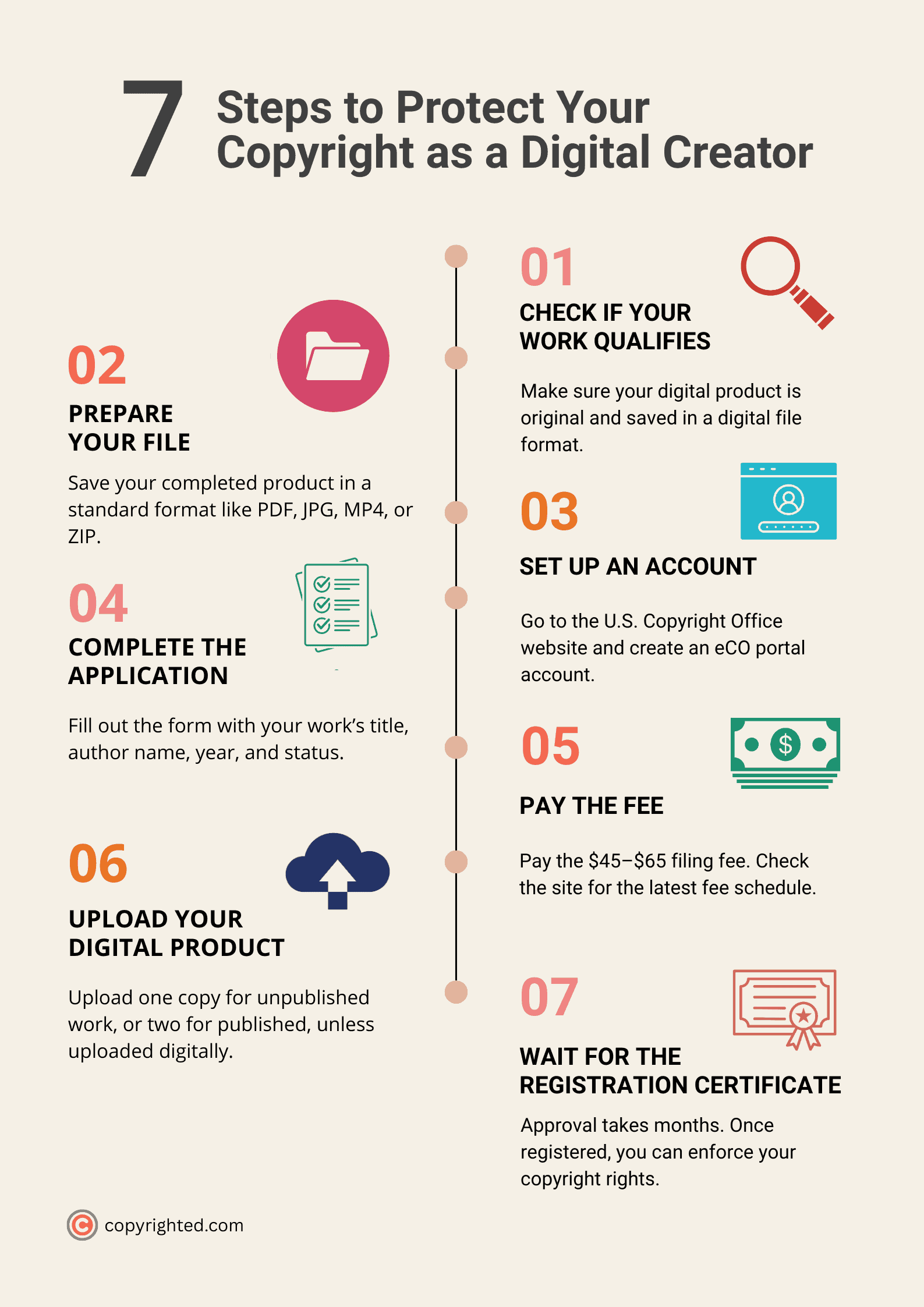
Step 1: Check If Your Work Qualifies
Before registering, make sure your digital product meets these basic requirements. It must be created in a file, document, or digital format.
Step 2: Prepare Your File
Have a complete version of your digital product ready and saved in a standard format such as PDF, JPG, MP4, DOCX, or ZIP, depending on the type of work. This file will be submitted as a “deposit copy.”
Step 3: Set Up an Account
Go to the U.S. Copyright Office’s website and create an account through the Electronic Copyright Office (eCO) portal. This account allows you to file and manage your registrations online.
Step 4: Complete the Application
Select the category that best fits your work (literary, visual, software, etc.). The form will ask for:
- Title of the work
- Author’s name
- Year of creation
- Published or unpublished status
- Claimant details (often the same as the author)
Step 5: Pay the Fee
The filing fee for a single digital product created by one author and one claimant usually ranges from $45 to $65. However, fees may change, so checking the current schedule is best.
Step 6: Upload Your Digital Product
Submit your file through the online system, as one copy is usually sufficient for unpublished works. However, for published works, typically two copies are required unless your job is uploaded digitally.
Step 7: Wait for the Registration Certificate
Approval can take several months.
Once your registration is complete, you’ll receive an official certificate that grants you the right to take legal action if your work is copied or used without permission. You can also claim statutory damages and attorney’s fees under 17 U.S. Code § 411 and § 504.
How to Enforce Copyright for Digital Products
Registering your copyright is just the first step. If someone uses your digital product without permission, you have the legal right to take action.
While you don’t always have to go to court to enforce your rights, understanding your options gives you the power to protect your digital product.
Here’s how to enforce your copyright effectively:
Confirm There’s Infringement
First, ensure your work isn’t being used without your permission, as copyright infringement occurs when someone copies, distributes, displays, or creates a derivative of your work without authorization. This violates your rights under 17 U.S. Code § 106.
Gather evidence of the unauthorized use, such as screenshots, download links, dates, URLs, or any messages or promotional use of your content.
Check Your Copyright Registration
To file a lawsuit in the U.S., your work must be registered with the US Copyright Office. If you haven’t registered it yet, you can still ask platforms to remove the content, but you won’t be able to claim statutory damages or attorney’s fees until registration is complete.
Send a DMCA Takedown Notice
Under the Digital Millennium Copyright Act (DMCA), you can request that a website or platform remove the infringing content.
A proper DMCA notice should include:
- Your contact details
- A clear description of your copyrighted work
- The URL where the infringing material appears
- A good-faith statement that the use isn’t authorized
- Your electronic signature
Most platforms like YouTube, Amazon, and Etsy offer tools for submitting copyright complaints.
Contact the Infringer Directly
You can also send a cease-and-desist letter, a formal notice requesting the infringer to stop using your work and remove it. Stay professional and include proof that you own the copyright.
Consider Legal Action
If the infringement continues or causes harm, you can take the case to federal court. With a registered copyright, you may be entitled to:
- Statutory damages (up to $150,000 per work)
- Attorney’s fees and court costs
- A court order to stop the use (injunction)
Speak with an attorney who handles intellectual property cases before moving forward.
Monitor Your Work Regularly
Use alerts or monitoring tools to track where and how your work is being used online. Early detection helps you respond quickly and stay in control.
Frequently Asked Questions
How to protect the copyright of digital content?
Save your creative work in a fixed format and register copyright with the U.S. Copyright Office for stronger legal protection.
Do you need to register a copyright to protect your digital product?
No, protection starts automatically when the work is created, but registration is required to sue for damages.
Does your copyright cover international use?
Copyright laws vary by country, but many nations honor U.S. copyrights under international treaties like the Berne Convention.
Is it legal to sell digital products?
Yes, as long as you own the rights to the product or have permission to sell it.
What should you do if someone steals your digital product?
Gather evidence, send a DMCA takedown notice or cease-and-desist letter, and consider legal action if necessary.