Does copyright law create a monopoly? The short answer is no, but the confusion is understandable, especially with high-profile lawsuits involving music, books, or software.
In economic terms, a monopoly happens when a single entity dominates a market and restricts competition. Legally, a monopoly can refer to government-backed exclusivity, such as patents and copyrights.
But does copyright genuinely fall into this category?
This article clarifies the difference between copyright and monopoly, the legal definitions of a monopoly, and answers whether copyright is a legal monopoly.
Understanding this helps businesses, creators, and consumers navigate copyright’s impact on access to information, innovation, and competition.
- Copyright provides exclusive rights to creators but does not eliminate market competition, as it only applies to specific works, not entire industries.
- Legal monopolies exist in certain areas, such as patents and public utilities, but copyright differs because it allows for similar works and competitive alternatives.
- Copyright law includes limitations like fair use, compulsory licensing, and expiration to ensure public access and prevent monopolistic control.
Table of Contents
What is the Difference Between Copyright and a Monopoly?
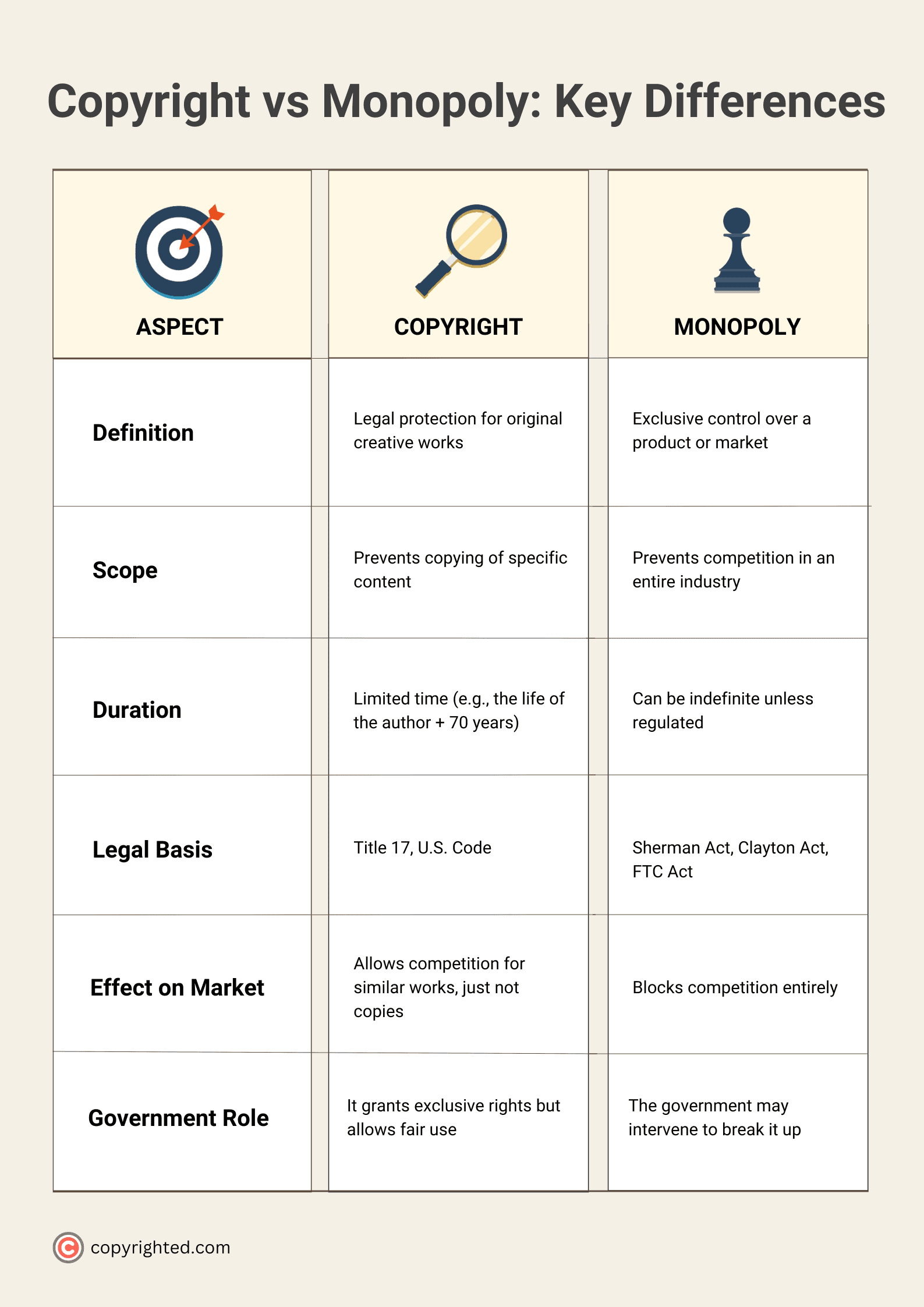
Copyright and monopoly involve exclusive control but serve different purposes in law and economics.
In copyright, creators such as authors and inventors have exclusive rights over their original work for a set period under the law. It includes control over reproduction, distribution, and public display.
However, this protection of the original work of authorship does not extend to an entire market, only to the specific work itself. Others can still create similar works if they do not copy the original.
In the U.S., these rights are governed by Title 17 of the U.S. Code, with similar regulations in other countries.
A monopoly occurs when one business or entity controls a product, service, or market, reducing competition and increasing prices. In the U.S., antitrust laws like the Sherman Act or 15 U.S.C. § 2 prevent monopolies that harm consumers.
Here’s a summary of the key differences between copyright and monopoly:
What is a Legal Monopoly?
A legal monopoly is an exclusive right granted by the government, allowing a person or company to operate in a specific market with limited competition.
Unlike illegal monopolies resulting from anti-competitive practices, legal monopolies exist because the law allows or requires them. They are typically granted to encourage innovation, ensure public service access, or protect intellectual property.
These monopolies can exist in different industries, from utilities to patents. Here are some examples of legal monopolies:
- Patents: The U.S. government grants patents under 35 U.S.C. § 101, giving inventors exclusive rights for up to 20 years. It encourages innovation by allowing inventors to profit before others use their ideas.
- Public Utilities: Government-backed monopolies often control services like electricity, water, and gas to maintain stability. Regulations help prevent high prices and poor service.
- Postal Service: The United States Postal Service, or 39 U.S.C. § 601, has a legal monopoly on delivering first-class mail. Private companies cannot compete directly in this area.
- Trademarks:While not absolute monopolies, trademarks, which are governed by 15 U.S.C. § 1051 under the Lanham Act, give exclusive rights to use specific brand names or logos in commerce.
Legal monopolies differ from anti-competitive monopolies because they are usually regulated and temporary.
Is Copyright a Legal Monopoly?
No, copyright is not a legal monopoly.
Copyright grants exclusive rights over an original work but does not eliminate market competition entirely. Unlike a traditional monopoly, copyright does not prevent others from creating similar or competing works and stops them from copying the exact content.
Under 17 U.S.C. § 106, copyright owners have the exclusive right to reproduce the work, distribute copies, and perform or display the work publicly. These intellectual property rights ensure that creators can control how their work is used, giving them financial and creative incentives.
Even though copyright gives exclusive control over a work, it does not:
- Prevent others from doing similar work on their own. For instance, two authors can write books about the same historical event.
- Control the entire market. One example is that multiple superhero franchises exist despite copyright protections.
- It lasts forever because copyright has time limits. The copyright duration equals the author’s life plus 70 years under 17 U.S.C. § 302.
A true monopoly restricts competition by controlling an industry, like a utility company with no rivals. Copyright only protects one version of an idea, allowing others to create their independent works.
Let’s take JK Rowling’s copyright as an example, which prevents direct copies of Harry Potter but does not stop others from writing fantasy books about wizards. Another one is that Disney owns copyright over The Lion King, but other studios can make animated films about animals.
Since it does not block competition in the marketplace, copyright is not a monopoly but a limited exclusive right to balance creative incentives with public access.
Limitations on Copyright as a Monopoly
While copyright grants exclusive rights, it is not absolute. Several legal limitations prevent it from functioning as a true monopoly. These rules allow for public access, encourage creativity, and ensure copyright holders do not have total control over cultural and informational works.
Fair Use Doctrine
Under 17 U.S.C. § 107, the Fair Use Doctrine allows copyrighted material to be used without permission in specific situations. It prevents copyright from restricting education, commentary, and creative transformations.
Courts analyze four factors when determining fair use, which are:
- Purpose and character of the use: Nonprofit, educational, or transformative works like parodies are more likely to be fair use. A movie critic, for instance, can include short clips in a review without violating copyright.
- Nature of the copyrighted work: Nonfiction works generally receive less protection than fictional works. A journalist quoting a historical document has more flexibility than reproducing an entire novel.
- Amount and substantiality of the portion used: A small excerpt is more defensible than a work’s core part. A few lines of a poem in a scholarly analysis differ from reprinting the entire poem.
- Effect on the market: If the use does not harm the original creator’s ability to profit, it is more likely to be fair use. A teacher distributing a few pages from a book for discussion does not impact the book’s sales the same way as scanning and sharing the entire text online.
Compulsory Licensing
The US Copyright Act sometimes requires rights holders to allow others to use their work under a compulsory license, often at a regulated fee. It ensures that creators cannot entirely block access to their work when public interest is involved.
Under 17 U.S.C. § 115, songwriters cannot refuse to let others record and distribute cover versions of their songs as long as they receive royalties. This is why artists can legally release cover songs, even if the original songwriter objects to them.
Television broadcasts also fall under compulsory licensing.
According to 17 U.S.C. § 111 & § 119, cable providers can retransmit network broadcasts as long as they pay the required statutory fees. This prevents broadcasters from demanding exclusive control over public airwaves.
Expiration of Copyright
Copyright does not last forever. All works eventually enter the public domain, allowing anyone to use them freely.
For works created by individuals, copyright lasts the author a lifetime plus 70 years. Corporate works, such as movies or software owned by companies, are protected for 95 years from publication or 120 years from creation, whichever is shorter.
Frequently Asked Questions
How does copyright enforcement impact market competition?
Copyright enforcement protects original works without restricting market competition, as others can create similar works without copying the original.
Can a company monopolize content using copyright?
No, copyright only protects specific works, not entire ideas or markets, preventing absolute monopolization.
Can multiple companies hold a copyright monopoly?
No, since copyright applies to individual works, multiple companies cannot monopolize an entire industry but only their specific creations.
Can copyright laws create monopolistic control over an industry?
No, copyright laws grant exclusive rights over specific works but do not prevent others from competing with similar, original content.
Does copyright stifle innovation like monopolies do?
No, copyright encourages creativity by protecting creators while allowing competition through independent works and fair use.