Navigating intellectual property laws can be challenging, especially when it comes to understanding the difference between copyright and trademark.
Misunderstanding these terms might lead to incorrectly protecting your brand or creative work—or even not protecting it at all. Such confusion can result in missed opportunities, financial setbacks, or losing control over your ideas.
It’s simpler than it seems, and once you understand the basics, protecting your creations and brand becomes much easier. This article simplifies these concepts for you.
By the end, you’ll understand the difference between trademark and copyright, how each works, and when to use them.
- Trademarks protect brand identifiers like names and logos, while copyright protects original creative works.
- Trademarks are governed by the Lanham Act, and copyrights by the U.S. Copyright Act, each with distinct protection mechanisms.
- Both trademark and copyright protections can apply to the same item, providing comprehensive brand and creative content security.
Table of Contents
Trademark vs Copyright: What Are the Differences?
Trademark or copyright offer intellectual property protection but serve very different purposes.
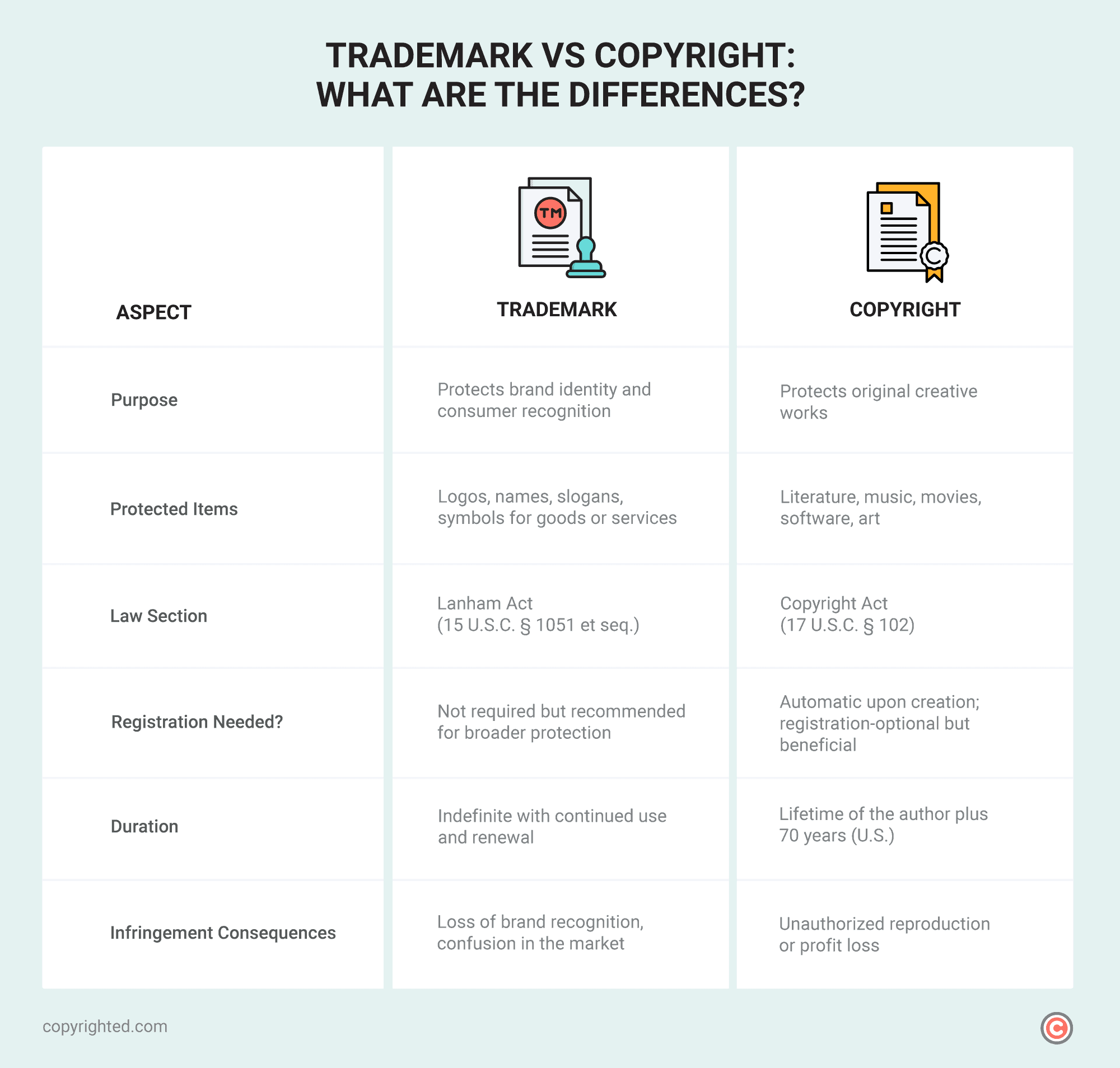
A trademark protects names, logos, and symbols identifying a product or service, helping consumers distinguish one brand from another. By law, trademarks protect brand identity and prevent confusion in the marketplace.
The Lanham Act (15 U.S.C. § 1051 et seq.) governs trademarks in the United States.
On the other hand, copyright safeguards original works of authorship, such as books, music, movies, and software. Copyright gives creators exclusive rights to reproduce, distribute, and display work.
The U.S. Copyright Act, 17 U.S.C. § 102, outlines the rights and protections for copyright holders.
If you need a trademark vs copyright summary, here’s a brief comparison to highlight the main differences:
When Should You Use Trademark?
Federal trademark registration is important in several scenarios. Here are key situations where a trademark provides the most benefit:
Protecting Brand Names and Logos
When you have a unique name or logo that identifies your business or product, trademarking helps protect it. This protection ensures no one else can use a similar name or logo in a way that could confuse customers.
Under 15 U.S.C. § 1052, trademarks help prevent the misuse of identifying symbols, words, or designs tied to your brand.
Distinguishing a Product or Service in the Marketplace
For businesses offering unique products or services, a trademark helps differentiate your offerings from competitors.
By trademarking distinctive elements like a slogan, color scheme, or specific packaging, you make it easier for customers to identify and trust your product or service among many options.
Expanding a Brand Nationally or Internationally
Trademark protection is especially valuable during national or international expansion because it secures your brand’s identity across new markets.
Trademark registration with the United States Patent and Trademark Office (USPTO) provides nationwide protection in the U.S. It can also open pathways for international trademark rights under treaties like the Madrid Protocol.
Licensing and Franchising Opportunities
Trademark protection allows you to license or franchise your brand, enabling others to use your trademarked symbols or names legally while maintaining control over the quality and consistency of your brand representation.
Through licensing agreements, you can generate revenue without giving up ownership, with the assurance that the law will protect your trademarked assets.
When Should You Use Copyright?
Protecting copyright is essential for creators seeking exclusive rights over their original works. Here are key situations where copyright offers significant benefits:
Protecting Original Literary and Artistic Works
Copyright is automatically granted to original works fixed in a tangible form, per 17 U.S.C. § 102. This covers books, visual art, music, and software, allowing creators to control their work’s reproduction, distribution, and display.
Controlling Digital Content Use and Distribution
In a digital age, online content—like articles, videos, and software—is vulnerable to unauthorized use. Copyright gives creators exclusive rights over publication and distribution, helping them monetize digital content and prevent unapproved sharing.
Securing Revenue from Creative Work
Copyright allows creators to license their work, such as selling book publishing rights or licensing an image for commercial use. This ensures they can profit from their creations while retaining ownership and legal backing.
Protecting Against Unauthorized Reproduction and Adaptation
17 U.S.C. § 106 protects creators against unauthorized copying, distribution, and adaptation of their work. This includes exclusive rights to create derivative works, such as novel adaptations into a film.
Establishing Ownership in Collaborative Projects
Establishing copyright ownership is necessary when multiple individuals or entities collaborate on a project.
Copyright law supports “joint works” and “works made for hire,” enabling clear ownership in collaborative projects. This clarifies rights among all contributors, simplifying licensing, royalty sharing, and project management.
Preserving Rights Beyond the Author’s Lifetime
Copyright protection lasts the author’s lifetime plus 70 years, according to 17 U.S.C. § 302. This allows heirs to control and benefit from the work for decades.
For corporate or anonymous works, protection extends to 95 years from publication or 120 years from creation, securing long-term value.
Can You Use Both Trademark and Copyright?
Yes, trademark and copyright protections can apply to the same item if it meets each type’s criteria. While they serve distinct functions, they can work together to safeguard brand identity and creative content.
Here are examples of common uses for both protections:
Logos and Brand Designs
Trademark a logo to protect it as a brand identifier, which prevents similar logos that could mislead consumers. Meanwhile, copyright registration with the U.S. Copyright Office covers the logo as an original artistic work.
Characters and Product Mascots
When a brand uses a unique character, such as a cartoon mascot, to represent its products, copyright can protect that character’s artistic and literary aspects. For example, the copyright covers these creative expressions if the character is used in a series of animated shorts or comic books.
Additionally, when marketing uses trademark protection for the character’s name, image, or catchphrases, consumers associate the character with that brand. This combination ensures that competitors can’t create a similar character to attract the same audience.
Packaging and Product Design
Distinctive packaging or product designs may hold both protections: copyright for the design as a creative work, like the cereal box art, and trademark if the packaging serves as a brand identifier.
Websites and Software
Websites and software are often protected by copyright for elements like content, graphics, videos, and code. Trademark protection applies to brand identifiers, such as logos and taglines displayed on the site or software, securing the brand’s identity.
For example, an app’s logo is trademarked, while its code, interface design, and artwork are copyrighted.
How to Choose the Right Protection for Your Work?
Choosing between copyright or trademark protection depends on factors like the nature of your work, its intended use, and the legal protection you need.
Here are key points to guide your decision:
Identify the Purpose of the Work
Ask yourself: Is the primary role of this work to identify my brand, or is it an original creative piece?
A trademark is appropriate if the work’s main purpose is to represent your brand (like a logo or slogan). If it’s a creative work, such as a book or painting, copyright provides the right protection.
Determine How You Will Use the Work
Ask yourself: Will this work promote a brand or stand alone as creative content?
Use a trademark if the work will identify or promote your brand. For creative content meant to be consumed, like literature or music, copyright helps you control its reproduction and distribution.
Consider the Longevity of Protection Needed
Ask yourself: Do I need protection indefinitely or for a limited time?
Trademarks can be renewed indefinitely as long as they are active, making them ideal for lasting brand elements. Copyrights last the author’s life plus 70 or up to 120 years for corporations, which is suitable for time-limited creative works.
Assess the Type of Legal Protection Required
Ask yourself: Do I need to protect against brand misuse or unauthorized copying?
Trademark law prevents other businesses from using your brand elements in ways that might confuse consumers. Copyright protects against unauthorized copying, distribution, and adaptation of your original work, giving you control over its use.
Frequently Asked Questions
How long does a trademark last compared to a copyright?
A trademark lasts indefinitely with renewal, while a copyright typically lasts the author’s lifetime plus 70 years.
If you trademark my business name, do you also need a copyright?
No, a trademark can protect your business name, logo, or slogan related to branding. You don’t need a copyright for a business name alone.
Can copyrighted material be trademarked by someone else?
Creators can avoid issues by researching copyrights, seeking permissions, understanding fair use, and consulting experts for legal advice.
Can copyright laws stifle innovation?
Yes, by restricting access to foundational works, copyright laws can slow the exchange of ideas necessary for innovation.
What are the copyright issues related to AI and machine learning?
AI and machine learning face copyright concerns due to reliance on large datasets, often composed of copyrighted works.